How Mobile Locksmiths Can Stop Answering Calls While Driving (2026)
Every mobile locksmith knows the moment: the phone rings on the highway and the next job is on the line. Here is why answering while driving is a losing bet in 2026 — and how to stop without losing a single call.
How Mobile Locksmiths Can Stop Answering Calls While Driving (2026)
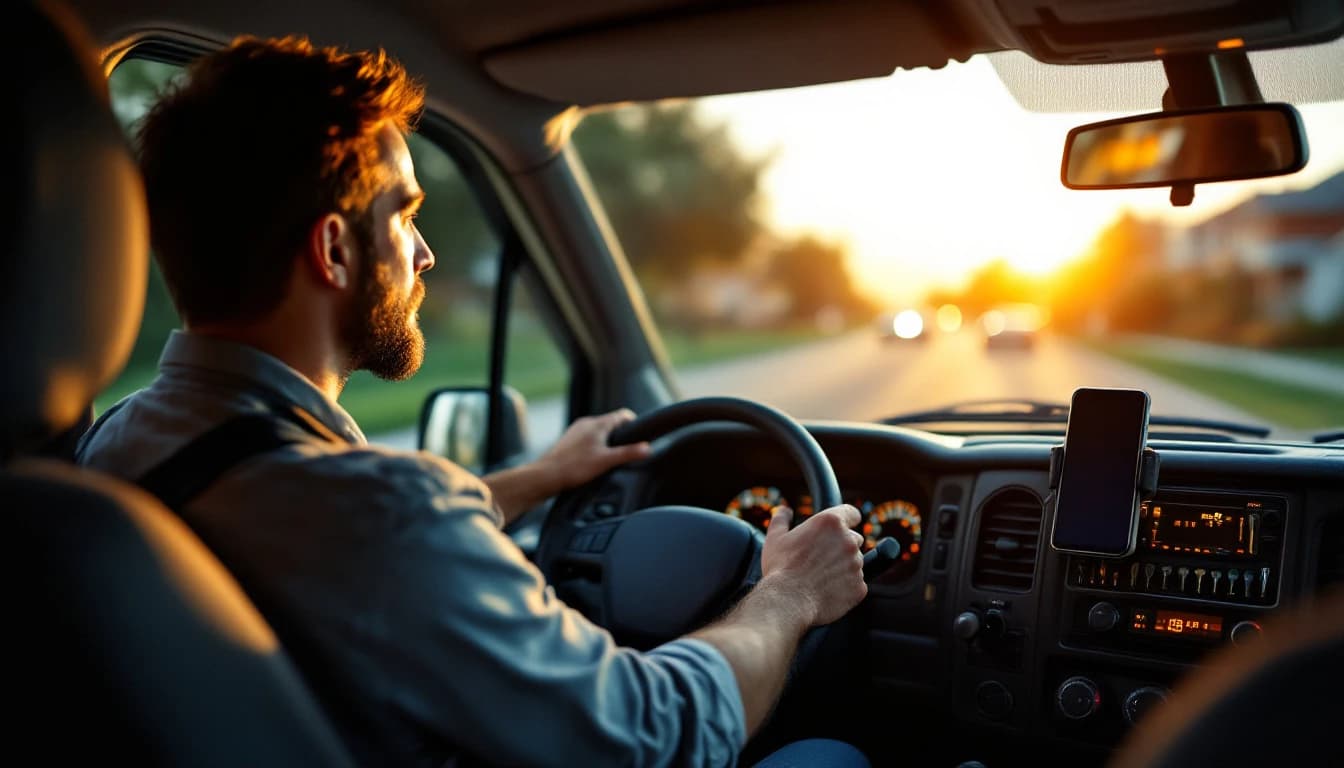
There is a moment every mobile locksmith knows by heart. You are doing 70 on the interstate, twenty minutes out from a lockout, and the phone lights up with a number you don't recognize. You have about four rings to make a decision that pits your safety and your license against your revenue. Answer, and you are now negotiating a car key quote at highway speed. Decline, and that caller — very possibly a $300 job — is already dialing the next locksmith on the search results.
As of July 2026, that dilemma is sharper than it has ever been. Hands-free and distracted-driving laws have tightened across much of the country, insurers scrutinize commercial drivers more closely than ever, and customers have less patience for voicemail than at any point in the history of the telephone. The old compromise — answer fast, talk short, hope for the best — is failing on both ends: it is legally riskier than most owners realize, and it still loses jobs, because a rushed thirty-second call from a moving van rarely converts the way a calm, complete quote does.
This guide walks through the real shape of the problem — the legal exposure, the liability math, and the revenue math — and then through the solution that has actually changed the equation for one-truck operators: 24/7 AI call answering that picks up every call instantly, quotes it, books it, and has the job waiting in your calendar when you park.
The legal landscape: hands-free is no longer optional
Start with the law, because it is the part most owners underestimate. Distracted driving is regulated state by state in the United States, and the trend over the past decade has moved in exactly one direction: stricter. A majority of states now have some form of hands-free requirement for drivers, many ban all handheld phone use outright, and enforcement has shifted from secondary to primary in state after state — meaning an officer can pull you over for the phone alone, no other violation required.
The National Highway Traffic Safety Administration (nhtsa.gov) has made distracted driving a headline safety priority for years, and its public materials are unambiguous: you cannot drive safely unless the task of driving has your full attention, and no occupation is exempt from that. The Federal Communications Commission (fcc.gov) likewise publishes consumer guidance on the dangers of texting and calling behind the wheel. Neither agency carves out an exception for "but the call was worth $300."
Two details matter specifically for locksmiths:
You are a commercial driver in the eyes of almost everyone who matters. Even if your van does not require a CDL, you are driving for business purposes, in a branded vehicle, with commercial insurance. Violations and at-fault incidents hit differently than they would on a personal policy — premiums, exclusions, and in serious cases the viability of your coverage are all in play.
A quote call is not a quick call. Hands-free laws generally permit voice calls through Bluetooth, and some owners treat that as a full solution. But think about what a locksmith intake call actually requires: the caller's location, the vehicle year, make and model, the service type, a price lookup, an ETA estimate, and ideally a confirmed booking. That is not a hands-free conversation — that is a data-entry task. The moment you reach for a notepad, a pricing sheet, or the calculator app at a red light, you are back in violation territory, and more importantly, you are back to dividing attention you cannot afford to divide.
The liability math nobody wants to run
Set the tickets aside and consider the scenario that keeps commercial insurers awake: an at-fault accident in your work van, with phone records showing an active call at the time of impact. In civil litigation, those records are discoverable, and plaintiff attorneys know exactly what to do with them. A crash that might have been an ordinary claim becomes a negligence narrative — a business owner who chose revenue over road safety — with your call log as Exhibit A.
Hands-free doesn't make the conversation free: as NHTSA's distracted-driving page puts it, you cannot drive safely unless driving has your full attention, and a pricing conversation takes some of it. For a one-truck operation, a single serious at-fault incident can mean the truck, the tools, the insurance rating, and the owner's health all at once. There is no job on the other end of the line worth that stack of risk. The problem is that declining the call has always felt like it costs real money — so let's look honestly at that side of the ledger too.
What declining the call actually costs
The instinct to answer at 70 mph is not irrational. It is a correct read of how emergency locksmith demand works. A locked-out caller is in a now-problem, and now-problems do not wait on voicemail. The data patterns are consistent across the industry: callers who reach voicemail overwhelmingly do not leave a message — they hang up and dial the next result. We've broken down the revenue impact in detail in what missed calls actually cost a locksmith business, and the short version is brutal: for an average mobile locksmith, every missed emergency call is a coin-flip on a few hundred dollars that almost always lands in a competitor's pocket.
Speed matters even when you do call back. Our analysis of speed-to-lead for locksmiths shows the conversion window on an emergency call is measured in seconds and minutes, not hours. A callback from the parking lot twenty-five minutes later usually reaches a customer who has already booked someone else — or reaches nobody at all.
So the driving locksmith faces what looks like an impossible choice:
- Answer while driving — legal risk, liability risk, safety risk, and a rushed call that converts poorly anyway.
- Let it ring to voicemail — safe and legal, but the job is gone.
- Pull over for every call — safe, legal, and completely impractical when you are billing by the job and the next customer is waiting in a parking garage.
For years, those were genuinely the only three options. They are not anymore.
Why the old workarounds fail
Before looking at AI answering, it is worth being honest about the patches mobile locksmiths have traditionally tried, because each one fails in a predictable way.
Bluetooth and voice answering. Solves the handheld violation, does not solve the cognition problem or the data problem. You still cannot look up a 2019 Silverado prox key price, quote it accurately, and book a 2 PM slot while merging.
Forwarding to a spouse or family member. Free, and better than voicemail — but the person answering usually cannot quote, books conservatively or not at all, and burns out fast. Callers can hear when they have reached someone guessing.
A human answering service. Professional pickup, but generic answering services take messages; they do not quote car keys by year, make and model, and a message taken is still a callback you have to make from the road. We compared the models directly in AI receptionist vs. human answering service, and for quote-driven trades the message-taking model leaves most of the value on the table.
"I'll call them right back." The most common strategy and statistically the worst, per the speed-to-lead numbers above. Emergency demand does not queue.
Here is how the options stack up for a mobile locksmith who spends four to six hours a day behind the wheel:
| Option | Legal/safety risk | Answers instantly | Quotes accurately | Books the job | Works at 2 AM |
|---|---|---|---|---|---|
| Answer while driving | High | Yes | Rarely (rushed) | Sometimes | Only if you're awake |
| Voicemail + callback | None | No | Too late | Too late | No |
| Family member answers | None | Sometimes | No | Rarely | No |
| Human answering service | None | Usually | No (messages only) | Rarely | Extra cost |
| AI receptionist | None | Yes, every call | Yes, by year/make/model | Yes, on the call | Yes |
What full AI call coverage looks like from the driver's seat
An AI receptionist built for locksmiths changes the shape of the workday because it removes the phone from the driving equation entirely — not by suppressing calls, but by handling them completely.
Here is the sequence when a call comes in while you are driving:
- Instant pickup, every time. The AI answers on the first ring, in English or Spanish depending on the caller, 24 hours a day. No hold, no voicemail, no busy signal — even when two calls land at once.
- Real qualification. It collects exactly what you would: location, vehicle year, make and model, service type, urgency. It screens out the robocalls and solicitors that make up a shocking share of a locksmith's inbound volume.
- An accurate quote on the call. Because it quotes from your actual price book by vehicle — the same way we described in how AI quotes car key replacement by year, make and model — the caller hears a real number, all-in, including any after-hours surcharge. No "someone will call you back with pricing."
- Booking and dispatch. The job lands on your calendar with the address, vehicle, and quoted price attached, and GPS-aware dispatch means the schedule reflects where your truck actually is.
- You find out when it's safe. You finish the job you were driving to, check your phone in the parking lot, and the next job is simply there — booked, priced, confirmed.
The psychological shift is as valuable as the revenue math. Owners who make this switch describe the same thing: the ringing phone stops being a threat. You stop doing risk arithmetic at highway speed because there is no longer a decision to make. Every call is being answered better than you could answer it from the van — calmly, completely, with the price book open.
This matters most for the solo operator and the two-truck shop, which is exactly who mobile locksmith coverage was designed around. A dispatcher-backed six-truck operation has options. The owner-operator whose phone is the dispatch desk has, until recently, had none.
Making the transition without dropping calls
Switching from answer-it-yourself to AI coverage is not a leap of faith; it is a forwarding rule. Practical notes from shops that have done it:
Keep your number. Your existing business line simply forwards; callers notice nothing except that the phone now gets answered on the first ring, every time. Most of TheKeyBot's setup is loading your price book and service area.
Load real prices, not placeholder prices. The AI is only as good as the price book behind it. Spend the setup window getting your by-vehicle pricing and your after-hours rules right — the payoff is that every quote it gives is one you are happy to honor. Our guide to after-hours and emergency pricing covers how to structure the surcharge so it is quoted up front.
Decide your interruption rules. Most owners route true emergencies (a child locked in a car, an active safety issue) to break through to their cell, while everything else books to the calendar. You define the triage; the AI applies it identically on every call.
Watch the first week's transcripts. Every call is recorded and summarized, so you can see exactly what was asked and how it was answered — and tighten wording or pricing rules where you want to. Most owners find the AI is more consistent on the phone than they are, mostly because it is never merging onto a highway mid-sentence.
The bottom line
Answering calls while driving was always a bad trade — it just used to be a bad trade with no alternative. In 2026 the legal exposure is higher, the liability discovery is easier, and customer patience for voicemail is lower, while the alternative has become genuinely better than the thing it replaces: an AI receptionist answers instantly, quotes accurately from your real price book, books the job into your calendar, and does it in English and Spanish at any hour, for less than the cost of the jobs a single month of highway voicemail loses. Forward the phone, keep your eyes on the road, and let the calendar fill itself. Start with TheKeyBot's plans and pricing or see everything the platform handles on the features overview.
Frequently asked questions
Is it legal for a mobile locksmith to answer calls while driving?
It depends on your state, but the trend is firmly against it. Many states now ban all handheld phone use while driving and enforce it as a primary offense, and even hands-free calls remain legal only within limits that a real locksmith intake call — with price lookups and note-taking — quickly exceeds. Check your state's current law and see nhtsa.gov and fcc.gov for federal safety guidance on distracted driving.
How many jobs does a mobile locksmith actually lose to voicemail?
More than most owners estimate, because emergency callers rarely leave messages — they hang up and call the next locksmith in the search results. The conversion window on a lockout call is measured in seconds and minutes, so even prompt callbacks from a parking lot reach customers who have already booked elsewhere. Run your own numbers with the calculator at https://www.thekeybot.com/tools/missed-call-cost-calculator.
Can an AI receptionist really quote a car key job without me on the phone?
Yes — an AI receptionist built for locksmiths quotes from your actual price book by vehicle year, make, and model, including trip fees and after-hours surcharges, so the caller hears a real all-in number on the first call. TheKeyBot collects the vehicle, location, and service type, speaks the quote, and books the job into your calendar without a callback. Details at https://www.thekeybot.com/features/automated-quoting.
What happens with true emergencies while I'm driving?
You set the triage rules and the AI applies them on every call. Most owners configure genuine safety emergencies — like a child locked in a running car — to ring straight through to their cell or a designated tech, while standard lockouts and key jobs are quoted and booked to the calendar. Everything is recorded and summarized, so nothing reaches you as a surprise.
How much does TheKeyBot cost for a mobile locksmith?
TheKeyBot's Core plan is $500/month and includes 500 AI minutes with overage at 45¢ per minute. The Pro plan is $750/month for 1,000 minutes at 40¢ per minute overage, and the Elite plan is $1,200/month for 2,500 minutes at 35¢ per minute overage. Core, Pro and Elite answer 24/7 in English and Spanish, quote by vehicle, book appointments, and send payment links — full details at https://www.thekeybot.com/pricing.
Will callers know they're talking to an AI?
Callers get an instant, natural-sounding pickup that answers questions directly, and if asked, TheKeyBot answers honestly that it is the shop's automated assistant. What callers notice in practice is that the phone was answered on the first ring, they got a real price, and they got a confirmed appointment — which is a better experience than voicemail or a message-taking service on every measure that drives bookings.
Sources
- National Highway Traffic Safety Administration — distracted driving safety resources: https://www.nhtsa.gov/risky-driving/distracted-driving
- Federal Communications Commission — consumer guidance on phone use while driving: https://www.fcc.gov/consumers/guides/dangers-texting-while-driving
About the Author
TheKeyBot Team is dedicated to helping locksmiths grow their businesses through AI automation and smart technology. With years of experience in the locksmith industry, our team provides actionable insights and proven strategies.