The Caller Does Not Know What Key They Have — Identifying the Job by Phone (2026)
The most common reason an automotive locksmith quote turns into an argument in a driveway is that the caller could not tell you what they actually have. They know the year, the make and the color. They are frequently wrong about the trim and almost always wrong about the key. This is the phone-side field guide to resolving vehicle, key type and job scope before a number ever leaves your mouth.
The Caller Does Not Know What Key They Have — Identifying the Job by Phone (2026)
Ask any automotive locksmith what causes a bad job and you will get a list of villains — traffic, the wrong blade, a customer who wandered off, a dealer-only module. Ask them what causes a bad quote and the answer narrows to one thing. The number was built on what the caller said, and the caller was wrong.
As of September 2026, this is still the single most expensive failure in phone-based automotive locksmithing, and it is not a pricing problem. Your price book can be perfect. Your margins can be right. None of that survives a caller who tells you they have a 2017 Ford and a key that stopped working, when what they actually have is a 2017 truck with a proximity system, no working key at all, and the vehicle sitting in a tow lot forty minutes outside your radius. You quoted a spare. You are driving to an all-keys-lost job in the wrong place with the wrong stock, and the conversation you are about to have in that parking lot is going to be about why the price changed.
This is the field guide for the phone side. What the caller genuinely knows, what they only think they know, how to get to the VIN, how to explain key types in words a normal person can answer, the job-defining questions that have nothing to do with the key at all, and the operating rule that follows from all of it — never give a firm price until the key type is resolved.
What the caller reliably knows, and what they do not
Start by grading the inputs honestly, because the intake sequence follows directly from which fields are trustworthy.
They know the year, roughly. Usually within a year. That is often close enough to start, and frequently not close enough to finish, because platform changes do not respect model-year boundaries in the way people assume.
They know the make. Almost always right. This is your most reliable field.
They know the color, and it is useless to you. Except when there are two vehicles at the address, in which case it suddenly matters.
They think they know the model and trim, and they are often wrong. A caller with an SUV will name the family, not the variant. Trims and sub-models get merged in memory, and the differences between them can be exactly the differences that matter for key platform, immobilizer generation, or whether a blade is cut on the same profile.
They are almost always wrong about the key type. Not carelessly — the vocabulary simply is not theirs. Everything is a key, or a fob, or a clicker, or a chip key, and those words map onto the physical objects inconsistently from one caller to the next. A person can hold a remote head key and describe it as a fob, and a proximity fob and describe it as a key, and both feel accurate to them.
They often do not know whether they have one key or none. This is the one that costs real money. The caller says my key stopped working, which could mean a dead battery in an otherwise fine fob, a worn blade, a failed transponder, or that they have no working key and this one has been broken for a month. The gap between duplicating a working key and originating a key with none present is frequently the gap between two very different prices, and it is invisible to the caller because from where they are standing both situations look identical — they cannot start the car.
If you want the machinery behind turning those fields into a number once you have them, that is the subject of how AI quotes a car key replacement from year, make and model. This article is about the step before — making sure the fields going in are real.
The VIN is the resolution mechanism, and reading it aloud is the wrong way to get it
Everything above resolves to certainty with one number. The VIN identifies the platform, the model year as built rather than as remembered, and in most cases lets you determine key type, blade profile and programming path without relying on anything the caller believes.
Where it physically lives, in the order worth asking:
- Driver-side dash through the windshield. Stand outside the vehicle, look at the corner of the dashboard where it meets the windshield on the driver's side. This is the fastest one for a caller who is standing next to the car.
- Driver door jamb sticker. Open the driver's door and look at the pillar or the edge of the door itself. Useful when glare on the windshield makes the dash plate unreadable, which it very often does.
- Insurance card. In the caller's wallet or their insurance app. This is the best option when the caller is not with the vehicle.
- Registration. Glovebox, which is unhelpful during a lockout, or in a folder at home.
- Title. At home, or with a lienholder. Slow but definitive.
Now the part that matters operationally. Do not have the caller read the VIN to you digit by digit. Seventeen alphanumeric characters read over a mobile connection by a stressed person standing in a parking lot is one of the least reliable data transfers in this trade. The character confusions are systematic and predictable — the letters that sound like other letters, the digits that sound like letters, and the fact that VINs deliberately exclude some characters people will still say. One wrong character does not produce an error message; it produces a plausible-looking VIN for a different vehicle, which is worse, because you will act on it.
Ask for a photo instead. Have the caller photograph the dash plate or the door jamb sticker and text it in. It takes them ten seconds, it removes the transcription risk entirely, and it gives you an artifact you can re-read later when something does not add up. A texted photo of a VIN is worth more than a perfect verbal read, because you can check it twice.
The same logic applies to the key itself. If the caller has the key in their hand and cannot describe it, a photo settles the question faster than any amount of vocabulary. This is one of the highest-leverage habits available on the phone and it costs nothing.
The key taxonomy, in words a caller can actually answer
Here is the practical categorisation. Note that these descriptions are deliberately physical — shape, action, what it does — because a caller can answer a question about shape and cannot answer a question about transponder generation.
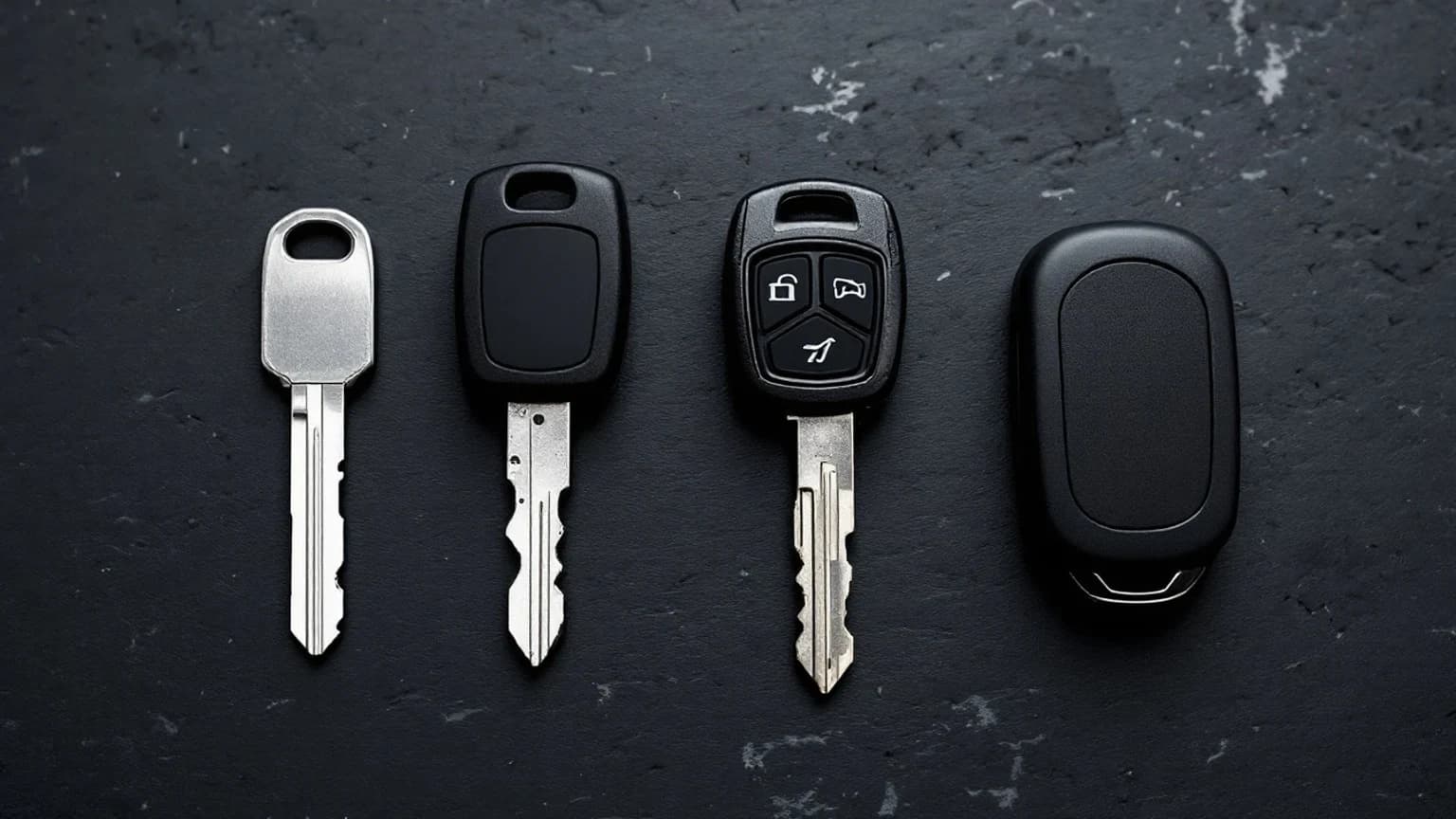
Plain metal key, no plastic head. All metal, no black or coloured plastic on the end, no buttons. Older vehicles and many secondary or valet keys. Physically simplest, cheapest to originate.
Metal key with a plastic head. A metal blade with a plastic top and no buttons on it. This is where the caller-knowledge gap opens up, because from the outside there is no way for them to tell whether there is a chip inside that head. Some are purely mechanical. Many are not. The plastic head is not evidence either way, and a caller will confidently tell you it is just a normal key.
Remote head key. The blade and the buttons are one single piece — the lock and unlock buttons live on the plastic head that the blade sticks out of. Common on a very large installed base. Callers routinely describe this as a fob, which is why the buttons-and-blade question below matters.
Flip key. The blade folds into the body like a pocket knife and flips out when you press a button. Distinctive enough that a caller can confirm it instantly once you describe the action.
Proximity fob. A fob you never take out of your pocket or bag. You walk up, the door unlocks or the handle works, and you press a start button to start the vehicle. Almost always the most expensive category and the one with the most programming variability.
Card key. A flat card rather than a fob. Rare, brand-specific, and worth identifying explicitly because it changes the parts conversation completely.
The questions that actually separate them. These four do nearly all of the work, and none of them require the caller to know any terminology:
- Do you put the key into a slot and turn it, or do you press a button to start the vehicle? This single question splits the entire population into mechanical-ignition and push-to-start, which is the biggest branch in the tree.
- Does the key fold out, like a pocket knife? Identifies a flip key in one answer.
- Do the buttons and the metal blade come apart, or are they one piece? Separates a remote head key from a separate fob-plus-key arrangement.
- Is there a metal blade on it at all? Confirms proximity, and sets up the trap described below.
Where you want a neutral outside reference for customers who want to read about car keys and fobs, the Associated Locksmiths of America publishes a consumer page on automotive locks, which notes that there is often a physical key stored inside the fob — but that is a link for your website, not a line in a phone script.
The traps worth naming
Three of these come up constantly, and each one has burned a firm quote.
Push-to-start vehicles usually still have a hidden emergency blade. The caller with a proximity fob says there is no metal key, because they have never seen one. There is frequently a small mechanical blade hidden inside the fob body, released by a catch, used to open the door when the vehicle battery is dead. That blade exists, it is cut to a real profile, and its presence or absence changes what you need on the truck. Ask specifically — is there a small button or slider on the fob that releases a little metal key — rather than accepting no metal key at face value.
The same model year can span two key platforms. This happens most visibly on trucks, where a body-style changeover or a running production change means that two vehicles wearing the same model year badge take completely different keys and programming paths. A caller cannot help you here at all; only the VIN can. This is the single strongest argument for the photo habit, because it is the case where being confidently wrong is easiest.
Sometimes the honest answer is the dealer or a specially ordered part. Some vehicles, some model years, and some security systems genuinely require a dealer path, a security code obtained through channels you do not have, or a part with a lead time. Telling a caller that on the phone costs you one job and buys you enormous credibility, and it is far cheaper than discovering it after a drive-out. A shop that says we cannot do that one, here is why is remembered better than a shop that tries and fails on site.
The job-defining questions that have nothing to do with the key
Key type sets the parts and programming. These set everything else, and skipping them is how a correctly-priced job still loses money.
Is this a lockout, a spare, or all keys lost? The three-way split that determines the entire job shape. Ask it explicitly and ask it early, in exactly those words plus a plain-language version — do you have a key that works right now, even one.
Is the vehicle drivable, and where exactly is it? Not the city — the actual location. A driveway, a workplace parking garage with a height restriction, a street with no parking, a tow lot with gate hours, an impound. Each of those changes access, time, and sometimes whether the job is possible today at all.
Is it in a garage, a tow yard, or somewhere with restricted access? Tow lots and impounds have hours, fees and paperwork the customer may not have anticipated, and a job that requires the customer to be present with documents at a facility that closes at five is a different job from one in a driveway.
Can the customer prove ownership? This is not optional and it is not adversarial — it is the part of the trade that keeps you out of trouble. Establishing it on the phone, before dispatch, avoids the worst version of the conversation, which is having it on site with somebody who has driven you there in good faith and cannot produce anything. The practical scripting for this is in proof of ownership and verification calls.
Who is the caller in relation to the vehicle? Owner, spouse, dealership employee, fleet manager, tow operator, roadside dispatcher. This determines authorisation, payment and often price tier.
And the urgency question. Is this a right-now problem or a this-week problem — because a stranded caller and a spare-key caller belong in different lanes with different response expectations. The triage logic behind that split is in emergency versus scheduled call triage.
What the caller says versus what it actually is
| What the caller says | What it might actually be | The disambiguating question | Why the price changes |
|---|---|---|---|
| My key stopped working | Dead fob battery, worn blade, failed transponder, or no working key at all | Do you have any key that starts the vehicle right now, even one that is awkward | Duplicating from a working key and originating with none present are different jobs |
| I just need a spare | A spare, or an all-keys-lost job the caller is describing optimistically | Can you start the car today with the key you have | All keys lost adds origination and often onboard programming steps |
| It is just a normal key, no buttons | A plain mechanical key, or a plastic-head key with a chip inside | Is there any plastic on the top of it, and does the car have an immobilizer light on the dash | A chipped key needs programming that a plain blade does not |
| I have a fob | A remote head key, a separate fob plus key, or a true proximity fob | Do the buttons and the metal blade come apart, or are they one piece | Proximity systems and remote head keys sit in different price bands |
| There is no metal key on mine | A proximity fob with a hidden emergency blade inside it | Is there a small catch or slider that releases a little metal key | The hidden blade still has a profile that must be cut correctly |
| It is a 2017 pickup | Either of two key platforms sharing that model year | Can you text a photo of the VIN from the windshield or door jamb | The two platforms take different keys and different programming paths |
The operating rule — a range with a resolution step, never a firm number on a guess
Everything above collapses into one policy for your phone process.
Do not state a firm price until the key type is resolved. Not because customers cannot handle uncertainty, but because a firm number given on a guess is a promise, and when it changes on site the customer does not hear a corrected estimate — they hear a bait and switch. That conversation costs you the job, the review, and often the referral behind it.
What to say instead is a range with a stated resolution step. For a vehicle of that year and make it is typically between this and this, and what settles it exactly is the VIN — text me a photo of the plate through the windshield and I will confirm the number before anybody drives anywhere. That sentence does four things at once. It gives the caller a real financial expectation. It is honest about the uncertainty. It names the specific thing that removes it. And it hands the caller a small task, which is a commitment device.
The corollary is that your price book has to be built to support ranges, not just point prices, and it has to be structured the way the phone actually asks questions rather than the way a parts catalogue is organised. That structure is the whole subject of building a locksmith price book for AI phone quoting, and the automated side of turning resolved fields into a stated number is on the automated quoting page.
For the jobs where the range is wide and the drive is long, a deposit taken on the phone is the mechanism that keeps a resolved-but-uncertain quote from turning into a wasted drive-out — the practicalities of collecting one without souring the call are in deposit collection by phone.
How an AI intake does this specifically
The reason this is a good fit for automated intake is that it is a decision tree, not a judgement call. The questions have a fixed order, the branches are known, and the failure mode is skipping a step under time pressure — which is exactly what a human does at 9 PM on the fourth call in twenty minutes and software does not.
A well-configured automotive intake asks the disambiguating questions in the order that eliminates the most uncertainty first. Push-to-start or turn-the-key, because that splits the population. Then one key or none, because that splits the price. Then the physical shape questions, because those settle the category. Then location, drivability, access and ownership. It captures the caller's own words rather than translating them into a dropdown, so that when two answers contradict each other — a caller who says push-to-start and also says they put the key in and turn it — the contradiction is visible to you rather than silently resolved in favour of whichever field was recorded last.
When the answers conflict, or when the year and make land on a platform boundary, the correct move is to stop guessing and text a photo request. That is a two-second action that converts a fuzzy field into a certain one, and it should be triggered by contradiction rather than by somebody remembering to do it.
And then the result has to land somewhere useful — the resolved vehicle, key type, job type, location, urgency and ownership status attached to the record rather than in a note nobody reads. Where that plugs into the rest of your stack is covered in integrations with your CRM, calendar and payments, and the broader automotive-specific tooling sits on the automotive locksmith software page.
On the entry plan this is message-taking rather than live quoting, and it is worth being precise about that. KeyBot Lite at $149 a month captures the structured intake — vehicle, key type answers, one-key-or-none, location, urgency — and delivers it to you; it does not quote live or book onto a calendar. The plans that quote from your confirmed price book and book on the call start at $500 a month for Core, and the full ladder including minutes and overage rates is on the pricing page. The fastest way to judge the questioning itself is to hear it — enter your company at the instant demo and it calls you back answering as your own shop.
The bottom line
Your caller knows the year, the make and the color. They are frequently wrong about the trim, almost always wrong about the key type, and often genuinely unsure whether they have one working key or none — and that last one is the difference between two prices. The resolution mechanism is the VIN, and the reliable way to get it is a texted photo of the dash plate or the door jamb sticker rather than seventeen characters read aloud over a bad connection. The key taxonomy has to be asked in physical terms a normal person can answer — do you turn it or press a button, does it fold, do the buttons and blade come apart, is there a metal blade at all — with the hidden emergency blade on proximity fobs and the split-platform model years as the traps that catch confident answers. Around all of it sit the job-defining questions that have nothing to do with the key at all — lockout versus spare versus all keys lost, drivable or not, where it actually is, whether a tow lot is involved, and whether ownership can be proved. And the rule that ties it together is simple. Quote a range with a stated resolution step, never a firm number on a guess, because a firm quote built on a guess does not get corrected in a driveway. It gets argued about.
Frequently asked questions
How do I get the VIN from a customer over the phone?
Ask them to text a photo of it rather than read it out. The plate is visible through the windshield at the driver-side corner of the dashboard, and there is usually a sticker on the driver door jamb that photographs more reliably when there is glare on the glass. Seventeen alphanumeric characters read aloud over a mobile connection produce systematic character confusions, and a single wrong character yields a plausible VIN for the wrong vehicle rather than an obvious error.
What is the fastest question to identify a customer key type?
Ask whether they put the key into a slot and turn it, or press a button to start the vehicle. That one question splits the entire population into mechanical-ignition and push-to-start, which is the biggest branch in the tree. From there, does it fold out like a pocket knife identifies a flip key, and do the buttons and the metal blade come apart separates a remote head key from a separate fob and key arrangement.
Why does one key versus no keys change the price so much?
Because duplicating from a working key and originating a key with none present are different jobs with different steps. With a working key present there is an existing programmed credential to work from. With none, the job typically involves origination and additional onboard programming, and it takes longer. Callers cannot see this distinction because from where they are standing both situations look identical — the car will not start — so it has to be asked explicitly rather than inferred.
Should I ever give a firm price before knowing the key type?
No. Quote a range with a stated resolution step instead — for a vehicle of that year and make it is typically between two figures, and what settles it exactly is the VIN. A firm number given on a guess is heard by the customer as a promise, and when it changes on site they do not hear a corrected estimate, they hear a bait and switch. That conversation costs the job, the review and often the referral behind it.
What does an AI intake cost for this kind of call?
KeyBot Lite is $149 per month with 100 calls included and 50 cents per minute after, no contract, live in about ten minutes, with the first 5 answered calls free inside a 7-day trial — on that plan it captures the structured intake rather than quoting live. The plans that quote from your confirmed price book and book on the call are $500 per month for Core with 500 AI minutes, $750 for Pro with 1,000, and $1,200 for Elite with 2,500, each with a 14-day free trial. Full details are at https://www.thekeybot.com/pricing.
What happens when the caller answers give contradictory information?
The right move is to stop and ask for a photo rather than silently resolve the contradiction. A caller who says push-to-start and also says they put a key in and turn it has given you two incompatible facts, and guessing which one is right is how a job arrives with the wrong stock. A photo of the key in their hand, or of the VIN plate, settles it in seconds and leaves you an artifact you can re-check later when something does not add up.
About the Author
TheKeyBot Team is dedicated to helping locksmiths grow their businesses through AI automation and smart technology. With years of experience in the locksmith industry, our team provides actionable insights and proven strategies.