Key Duplication Kiosk vs Locksmith: Which Saves Time
Automated key kiosks are cheaper and faster than a locksmith for basic house keys, and completely unable to help with most car keys. Here is exactly where the line falls, what each option costs, and why a kiosk cannot help you at 2 a.m.
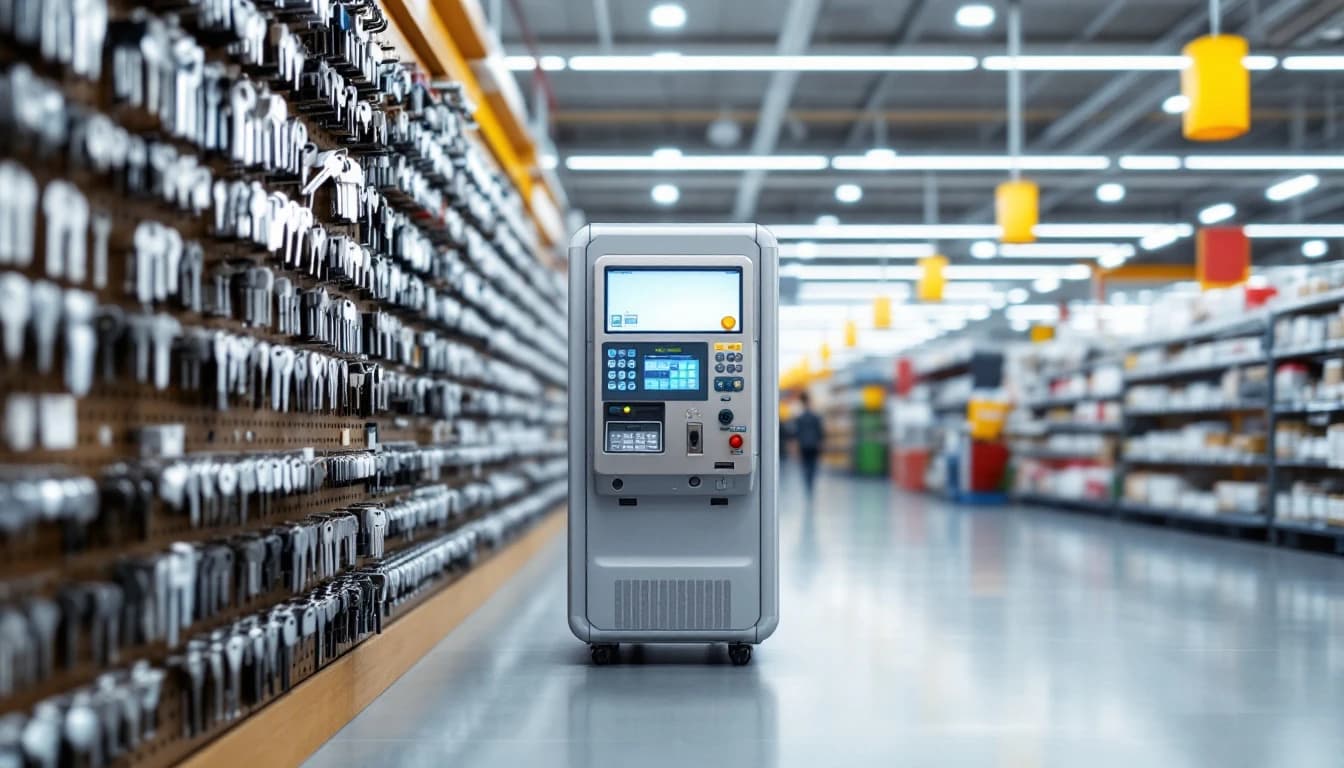
Key Duplication Kiosks vs a Locksmith: Cost, Reliability, and When Each One Works (2026)
An automated key kiosk is cheaper and faster than a locksmith for basic mechanical keys — typically a few dollars against a locksmith's higher minimum — but it cannot copy most car keys made in the last twenty-five years, and it cannot help you at all if you have lost every key you own. A kiosk copies the metal shape. Modern car keys also carry an electronic chip that must be programmed to your specific vehicle, and that step needs equipment a retail machine does not have.
That is the whole decision in two sentences. As of July 2026, the practical rule is: house keys and simple flat car keys from older vehicles go to the kiosk, anything with a chip or a button goes to an automotive locksmith or a dealer, and any emergency where you have no working key at all goes to a mobile locksmith regardless of price.
One quick clarification, because the names collide: TheKeyBot is not a key-cutting kiosk or a key-copying service. It is the AI phone system that locksmith shops and dealerships use to answer their calls, quote jobs, and book appointments around the clock. If you searched for a machine that cuts keys and landed here, the sections below still answer your question honestly — we just do not cut your key ourselves.
What a kiosk can and cannot do
The confusion between these options is almost entirely about one thing: whether your key has electronics in it.
A kiosk duplicates the physical cut. It scans the profile of the key you insert, selects a matching blank, and grinds an identical shape. For a key whose only job is to move pins in a lock cylinder, that is genuinely all that is required, and the machine does it well and cheaply.
A kiosk generally cannot program a transponder. Nearly every car built since the late 1990s has an immobilizer: a chip in the key head exchanges a coded signal with the vehicle, and if that handshake fails the engine will not start. You can cut a perfect metal copy of a transponder key, put it in the ignition, turn it, and get nothing. The metal is right and the car still refuses. Some kiosks offer a limited chip-cloning option for certain older, simpler systems, but coverage is narrow and it is not a general solution.
A kiosk cannot help with proximity or smart keys. If your "key" is a fob you leave in your pocket and you start the car with a button, there is no blade to scan and no shape to copy. That is a programming job, full stop.
A kiosk cannot do all-keys-lost. Every duplication machine needs an existing working key to read. If you have lost all of them, there is nothing to copy, and you need someone who can originate a key from the vehicle itself — reading the lock or pulling the key code from the VIN, then programming it to the immobilizer. That is a locksmith or dealer job every time.
A kiosk cannot come to you. It sits inside a store, on store hours, and your car has to be able to get there.
The real cost comparison
| What you need | Kiosk | Automotive locksmith | Dealership | The catch |
|---|---|---|---|---|
| House or padlock key copy | A few dollars, self-service | Higher, usually a shop minimum | Not offered | Kiosk wins clearly on price and speed |
| Older flat car key, no chip | A few dollars | Shop minimum, often modest | Marked up | Confirm it truly has no chip first |
| Transponder key (chipped) | Usually not possible | Cut plus programming, mid-range | Typically the most expensive route | Programming, not cutting, is the real cost |
| Smart key or proximity fob | Not possible | Higher, varies widely by make | Highest, often requires an appointment | The fob hardware itself drives much of the price |
| All keys lost | Not possible | Mobile service call plus origination | Requires towing the vehicle in | Locksmith is usually both cheaper and faster |
| Emergency, middle of the night | Closed | 24/7 mobile availability | Closed | Only a mobile locksmith answers |
Prices vary substantially by region, vehicle make, model year, and key type, so treat the relative ordering above as the reliable part and confirm the actual number locally before you commit. The one durable generalization worth internalizing: for chipped and smart keys, the cost is dominated by programming and by the price of the fob hardware, not by cutting metal. That is exactly why a machine that only cuts metal cannot be cheap-or-expensive at the job — it simply cannot do it.
A second durable generalization: for anything involving a chip, an automotive locksmith is very often less expensive than the dealership for the same result, and does not require you to get a non-starting vehicle onto a lot. Shops that specialize in this work quote by year, make, and model because those three facts determine the system involved — a process worth understanding if you want to compare quotes fairly, and one we break down in our piece on how car key replacement gets quoted by year, make, and model.
Are kiosk copies reliable?
For basic mechanical keys, generally yes — with one meaningful caveat that causes most of the complaints.
Copying a copy degrades. Every duplication introduces a small tolerance error. Cut a copy from a copy from a copy and those errors stack until the key binds, sticks, or stops turning in a worn lock. This is not unique to kiosks; it is true of any duplication. But because kiosks are cheap and convenient, they are where people most often copy an already-worn spare rather than an original. Always duplicate from your best original key, not from the spare you have been using for six years.
Blank quality and profile matching matter. A machine has to have the right blank for your key's profile. Unusual, restricted, or high-security profiles frequently are not stocked, and a near-match is not a match.
Restricted and "do not duplicate" keys are a separate category. Many commercial and apartment systems use patented keyways that legitimately cannot be copied without authorization from the property. A kiosk will typically refuse these, and that refusal is the system working correctly, not a malfunction.
Test the copy before you need it. Take the new key to the actual lock and cycle it several times, both directions, before you file it away as your emergency spare. A spare that has never been tested is not a spare; it is an assumption.
"I just moved and need extra keys" — the fastest route
This is one of the most common versions of the question, and the answer depends on a single factor most people skip past: should you be duplicating these keys at all?
If you have just moved into a home you now own, the standard recommendation is to rekey the locks rather than copy the existing keys. You have no way to know how many copies of the old key exist — previous owners, contractors, cleaners, neighbors, a real-estate lockbox. Rekeying changes the pins in your existing hardware so old keys no longer work, and it is typically far cheaper than replacing the locks themselves. Once rekeyed, you get a fresh set of keys, and then a kiosk is a perfectly good place to make additional copies.
If you are renting, do not rekey anything without your landlord's written permission — it is very often a lease violation, and in many cases the property is on a master system that a rekey would break.
So the fastest sensible sequence is: rekey first if you own and just took possession, then duplicate the new key at a kiosk for the cheap extra copies. Skipping straight to duplication saves ten dollars and leaves unknown keys in circulation.
The 24/7 emergency gap
Here is where the comparison stops being about price entirely.
If it is late at night and you are standing next to a car you cannot get into or cannot start, a kiosk is irrelevant. It is inside a closed store, it requires a working key you do not have, and it cannot travel. The only real option for a genuine emergency is a mobile automotive locksmith who answers the phone and drives to you. That is the service people are actually looking for when they search for emergency key replacement, even when they phrase it as a search for a machine.
Two practical notes for that situation:
Have your information ready before you call. Year, make, model, and whether you have any working key at all. Those four facts determine the equipment the tech needs to bring and whether the quote you are given is real. A shop that quotes without asking them is guessing.
Verify who you are calling. Emergency locksmith searches are a well-known target for deceptive listings — an operation advertises a low price, arrives, and demands far more once the work is underway. Confirm a real business name and address, get a firm quote on the phone before anyone is dispatched, and be wary of a quote that is dramatically below every other quote you got. The Federal Trade Commission publishes consumer guidance on avoiding exactly this pattern, and the Associated Locksmiths of America maintains resources on finding legitimate professionals. We have written separately about how fake listings and phone scams operate in this trade.
The uncomfortable reality of emergency locksmith work is that plenty of legitimate shops simply do not answer after hours — which is how the deceptive operators win the call. If you phone three local shops at midnight and two go to voicemail, the one that picks up gets your business regardless of whether it was the best choice. That answering gap is the problem our software exists to solve for shops, and it is covered in depth on our emergency lockouts page.
How to decide in thirty seconds
Look at the key in your hand.
Is it a plain flat metal key with no plastic head, no buttons, and no chip? Kiosk. It is the cheapest and fastest option and there is no meaningful downside.
Is it a house key and you just took possession of the property? Rekey first, then use a kiosk for extra copies.
Does it have a thick plastic head, buttons, or no blade at all? Automotive locksmith or dealer. A kiosk cannot do it, and trying wastes a trip.
Do you have zero working keys? Automotive locksmith. This is an origination job, not a duplication job.
Is it an emergency right now? Call a mobile locksmith who answers. Price comparison is a luxury you do not have at 2 a.m., but a firm quote before dispatch is not — insist on one.
For locksmith shop owners reading this
If you run a shop, the consumer confusion documented above is worth understanding as a business fact rather than an annoyance. A meaningful share of the people calling you have already tried a kiosk, discovered it could not do a chipped key, and are now calling with a half-formed idea of what they need and an anchored expectation of what it should cost.
That call is winnable, but only if two things happen: somebody answers it, and the person answering can immediately establish the year, make, and model, explain plainly why the price is what it is, and book the job before the caller dials the next shop. Those calls also cluster at exactly the hours a shop is least able to answer them — evenings and weekends, when the store the kiosk lives in has just closed.
That is the job our software does for locksmith shops: answering every call in English and Spanish, qualifying the vehicle, quoting from the shop's own price book, and booking the appointment, around the clock. You can see how it applies to key duplication and cutting operations specifically in our overview of how automation supports a key-copying shop, how the phone side works in automating customer calls, or start from the AI receptionist for locksmiths overview. Plans run $500 to $1,200 per month depending on call volume, detailed on the pricing page.
The bottom line
Automated key kiosks are genuinely good at one job: making cheap, fast copies of basic mechanical keys from a working original. For house keys, padlock keys, and old chip-free car keys, they beat a locksmith on both price and convenience, and there is no reason to pay more.
They cannot program transponders, cannot handle smart keys or proximity fobs, cannot originate a key when you have lost all of them, and cannot come to you at night. Those are not gaps that better machines will close soon, because the limitation is access to the vehicle's immobilizer rather than the ability to cut metal. For anything in that category, an automotive locksmith is usually both cheaper and faster than a dealership, and is the only option that travels.
Two things worth remembering beyond the price comparison: duplicate from your best original rather than from a worn spare, and if you have just moved into a home you own, rekey before you copy anything. Both cost very little and both prevent the failure people actually end up calling about.
Sources
- Federal Trade Commission — consumer protection guidance on hiring service providers and avoiding deceptive pricing: https://www.ftc.gov/
- Associated Locksmiths of America — professional standards and resources for finding a legitimate locksmith: https://www.aloa.org/
- U.S. Census Bureau — data on household moves and housing occupancy in the United States: https://www.census.gov/
Frequently asked questions
Is a key kiosk cheaper than a locksmith?
Yes, for basic mechanical keys a self-service kiosk is clearly cheaper, usually costing a few dollars against a locksmith's shop minimum. That advantage disappears entirely for chipped, transponder, or smart keys, because a kiosk cannot program them at any price and a locksmith or dealer is your only option. For those keys the cost is driven by programming and fob hardware rather than by cutting metal.
Can a key duplication machine copy a car key with a chip?
Generally no, because a kiosk copies the physical shape of the key while a transponder key also contains an electronic chip that must be programmed to your specific vehicle's immobilizer. A perfectly cut copy of a chipped key will turn in the ignition and still fail to start the engine. Some machines offer limited chip cloning for certain older systems, but coverage is narrow and it is not a general solution for modern vehicles.
Are automated key copying machines reliable?
For basic mechanical keys they are generally reliable, with one important caveat: always duplicate from your best original key rather than from a worn spare, because each duplication adds a small tolerance error and copying a copy causes keys to bind or stick. Unusual, restricted, or high-security key profiles often are not stocked as blanks, and patented do-not-duplicate keys will correctly be refused. Always test a new copy in the actual lock several times before storing it as your emergency spare.
What do I do if I lost all my car keys and have no spare?
Call a mobile automotive locksmith, because this is an origination job rather than a duplication job and no kiosk can help. Every duplication machine needs an existing working key to read, so with none available someone must originate a key from the vehicle itself by reading the lock or pulling the key code from the VIN, then program it to the immobilizer. A mobile locksmith is usually both cheaper and faster than a dealership here because your vehicle does not need to be towed anywhere.
Is there an emergency key service that operates 24/7?
Yes, mobile automotive locksmiths operate around the clock and travel to your vehicle, which is the only workable option for a middle-of-the-night lockout since kiosks sit inside stores on store hours. Have your vehicle year, make, model, and whether you have any working key ready before you call, since those facts determine both the equipment needed and whether a quote is genuine. Insist on a firm quote before anyone is dispatched, and be cautious of a price dramatically below every other quote you received.
Is TheKeyBot a key duplication service?
No, TheKeyBot is not a key-cutting kiosk or a key-copying service and does not cut keys for consumers. It is the AI phone system that locksmith shops and used-car dealerships use to answer inbound calls 24/7 in English and Spanish, qualify the job, quote from the shop's own price book, and book appointments. Plans run from $500 to $1,200 per month depending on call volume, with details at https://www.thekeybot.com/pricing.
About the Author
TheKeyBot Team is dedicated to helping locksmiths grow their businesses through AI automation and smart technology. With years of experience in the locksmith industry, our team provides actionable insights and proven strategies.